I think this is a perfect use case of Evaluate Function – Typst Documentation — you want to generate typst code and the possible expressions are limited.
#let expr(n) = {
  "sum_(i=1)^{n} i =".replace("{n}", str(n))
  for i in range(1, n) {
    "& {i} + \ ".replace("{i}", str(i))
  }
  "=& {}.".replace("{}", str(n * (n - 1) / 2))
}
#eval(expr(6), mode: "math")
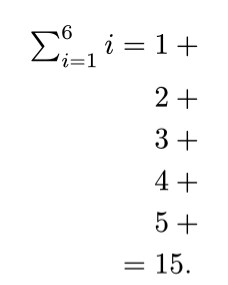
You may also generate it more programmatically as below, but I don’t think that would be more reliable than eval.
#{
  let align-point = $&$.body

  math.equation({
    import sym: eq, plus
    eq
    align-point
    "1"
    plus
    linebreak()

    align-point
    "2"
    plus
  })
}
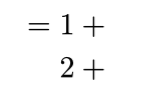
See also Pack complex content with data loading functions in Tips on debugging Typst code, including the dark magic
#raw(
  yaml.encode($= &1 + \ & 2 +$),
  lang: "yaml",
)
func: equation
block: false
body:
  func: sequence
  children:
  - func: symbol
    text: =
  - func: space
  - func: align-point
  - func: text
    text: '1'
  - func: space
  - func: symbol
    text: +
  - func: space
  - func: linebreak
  - func: space
  - func: align-point
  - func: space
  - func: text
    text: '2'
  - func: space
  - func: symbol
    text: +