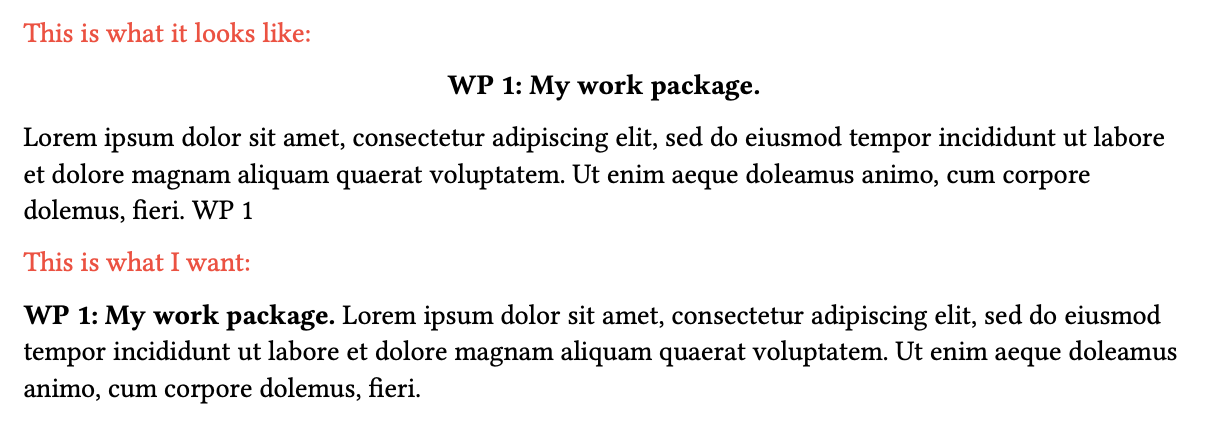
I’m trying to define a function that returns elements that can be referenced using ref. This works if the function returns a figure element and nothing else, but the figure is a block-level container and will force a paragraph break to the subsequent text:
#show heading.where(level: 3): it => [#it.body\.]

#let wp(x) =  {
  let title = context {
    [WP #counter(figure.where(kind: "wpfigure")).display(): #x]
  }
  figure(heading(level: 3, numbering: none, title), kind: "wpfigure", supplement: "WP")
}


#text(fill: red)[This is what it looks like:]

#wp[My work package] <wp1>
#lorem(30) @wp1


#text(fill: red)[This is what I want:]

=== WP 1: My work package
#lorem(30)
Oh, I’m sorry about that. Then there is enough going on with the default figure show rules that we can’t seem to override its kind of placement.
My guess about what’s happening, it’s like this:
#show block: box                // yes we can make the block inline
#show block: set align(center)  // unless we have this line; impossible to make it inline now
#block[Hello]<label> world
labelable: Set this to true to support outer label syntax: #elem(...) <label-here>. The downsides are that #show: e.prepare() becomes required to use the element, the element can no longer be inline, and show rules on the individual labels no longer have access to final fields.
This makes me think that there is no easy way to do this.
Yes, I have used this workaround too, I was just hoping one could use the normal label syntax.
I like their recommended syntax of #wp(label: <x>)[title], as opposed to the #wp([title], label: <x>) that I was using previously. I suppose I can live with that for now.