How could longer-form quotes be made more comfortable and clearer to understand? Screenplay packages like scriptie, its-scripted, screen-scripted and celluloid all appear to assume that
- each document refers to exactly one medium
- the play happens in the future, having no obvious mechanism to denote timestamps if it has already happened
- everything is continuous
These are suboptimal for art analyses and blog posts, where quotes are mixed-and-matched, then surrounded with a lot of contextualization/textual glue, reductively speaking.
Situation
I frequently interpret and analyze video and audio. Characteristics include:
- One quote refers to one medium (albeit the medium itself may reference other media).
- One quote has a start and an end that correspond to medium timestamps. Every quote should have at least one timestamp to facilitate verification.
- Multiple speakers may be involved, which can be textually identified. There is (at least) one exception: The only speaker is an unidentified narrator.
- Quotes may be long, sometimes even spanning several minutes.
What I do right now
Using Metropolis as an example:
#let qb(attribution, body, ..args) = quote(attribution: attribution, block: true, body, ..args)

#qb[@metropolis-1927[23:18 to 24:58]][
  / Joh: What were you doing in the machine halls, Freder?

  / Freder: I wanted to look into the faces
    of the people whose little children are my brothers, my sisters...

    Your magnificent city, father --
    and you the brain of this city --
    and all of us in the city's light -- --

    ...and where are the people, father,
    whose hands built your city -- -- --?

  / Joh: Where they belong...

  / Freder: ...where they belong...?

    ...In the depths...?

    What if one day those in the depths rise up against you?
]

#bibliography(bytes(`
metropolis-1927:
  type: video
  title: "Metropolis"
  date: "1927-01-10"
  runtime: "02:28:57"
`.text))
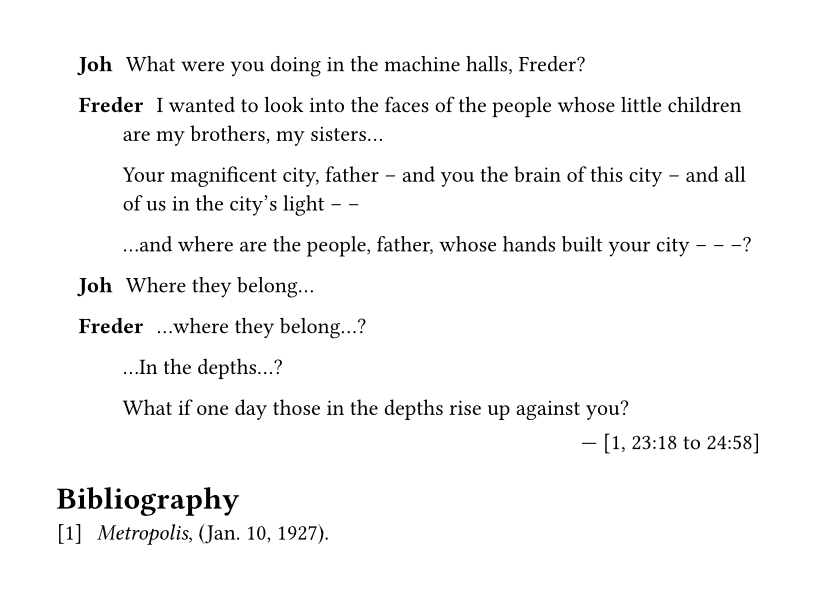
My gripes here:
- It is not possible to know when exactly each line is. (The entire section above is 1:40 long. I’d rather write the timestamp of each line once rather than having each verifying reader watch that duration.)
- The semantics are… off. In HTML export, this ends up as
dt. We define the same terms multiple times here, this does not feel correct.