This is not exactly the same, but maybe it could be used?
It shows that using set text() rules we can separate the four cases: emph, strong, strong(emph) and emph(strong). I don’t know if it’s sufficient, but if you can use the font’s covers options to set the font (instead of a regex rule), then you already have the separation of styles that you need.
- Will not handle nested strong and nested emph
- A style needs to be chosen for the combination of emphasis and strong. Pick a separate font for this case or other style tweak. We can’t of course apply two fonts at the same time, it has to be one or the other.
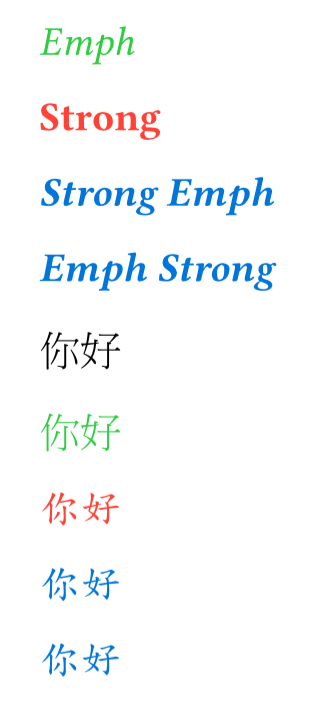
#let zhfont(x) = ((name: "Libertinus Serif", covers: "latin-in-cjk"), x)
#show strong: set text(red, font: zhfont("TW-MOE-Std-Kai"))
#show emph: set text(green, font: zhfont("MOESongUN"))

// Rules for both emph and strong
#show emph: it => {
  show strong: set text(blue, font: zhfont("TW-MOE-Std-Kai"))
  it
}
#show strong: it => {
  show emph: set text(blue, font: zhfont("TW-MOE-Std-Kai"))
  it
}

_Emph_

*Strong*

*_Strong Emph_*

_*Emph Strong*_

你好

_你好_

*你好*

*_你好_*

_*你好*_
(Note: my font selection was entirely random, just something that seemed to exist in the webapp. Happy to hear better suggestions.)