Now I feel more confident it what needs to be changed. The only thing I don’t like is “key” and “long”. I would use something like maybe “first”/“second” or “from”/“to”.
#let print-glossary(entry-list) = for entry in entry-list {
  show: block.with(spacing: 1em)
  strong(entry.key)
  h(.3em)
  emph(entry.long)
  if entry.description != none [: #entry.description]
  "."
}

/// Swaps key/long (English/Latin) values. Sorts by Latin.
#let glossary-english-to-latin(glossary-data) = {
  glossary-data
    .map(entry => array
      .zip(entry.long, entry.description)
      .map(((long, description)) => (
        (
          key: long,
          long: entry.key,
          description: if description != [] [#description],
        ),
      )))
    .flatten()
    .sorted(key: entry => entry.key)
}

/// Doesn't swap key/long (English/Latin) values. Sorts by English.
#let glossary-latin-to-english(glossary-data) = {
  glossary-data
    .map(entry => array
      .zip(entry.long, entry.description)
      .map(((long, description)) => (
        (
          key: entry.key,
          long: long,
          description: if description != [] [#description],
        ),
      )))
    .flatten()
    .sorted(key: entry => entry.key)
}


#let glossary-data = (
  (
    key: "Foo",
    long: ("Lorem", "Ipsum"),
    description: ([Comment A1], [Comment A2]),
  ),
  (
    key: "Bar",
    long: ("Dolor",),
    description: ([Comment B],),
  ),
)

#let english-to-latin-glossary = glossary-english-to-latin(glossary-data)
#let latin-to-english-glossary = glossary-latin-to-english(glossary-data)

=== English to Latin
#print-glossary(english-to-latin-glossary)

=== Latin to English
#print-glossary(latin-to-english-glossary)
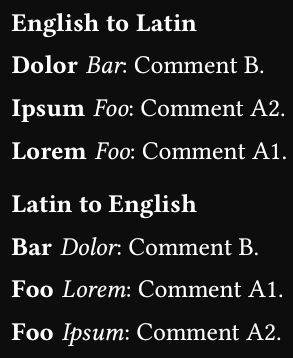
So, basically, we have the same input data, but then it’s passed through a processing function that spits out ready-to-print data. If you don’t need to access it, then just do
=== English to Latin
#print-glossary(glossary-english-to-latin(glossary-data))

=== Latin to English
#print-glossary(glossary-latin-to-english(glossary-data))
Inside, a lot of array methods were used in chains. For each entry, we go through a pair of long + description and make a new dictionary. Then sort by key and print.