I wrote my PhD thesis on AI and Natural Language Processing entirely in Typst! The overall experience was great, especially compared to my previous thesis, which I wrote in LaTeX (and which involved many hours of frustration…).
I didn’t use any official template, as my university didn’t provide one. Instead, I built the entire document from scratch, which turned out to be much easier than I expected. I was able to achieve almost exactly the layout and style I had in mind, with the possible exception of the bibliography, which seems to be a common challenge for thesis writing in Typst.
I could probably have taken advantage of more packages, but in the end I mainly relied on cetz and fletcher for diagrams, hydra for chapter headers, and flagada for national flags (I included several examples featuring text translated into different languages). I would also have loved to recreate my result charts using lilaq , but time was running short, so I ended up embedding them as PDFs.
I hope this might be useful or encouraging to someone considering Typst for a large academic project. Below are a couple of screenshots, along with some code snippets!
Source code
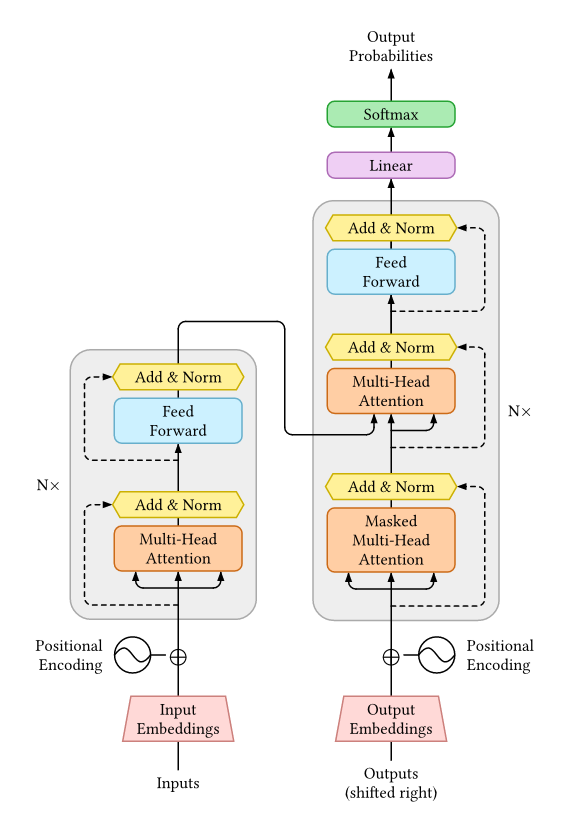
The code for the Transformer architecture figure from Vaswani et al. (2017) (code is a bit convoluted here, I warn you):
#import "@preview/fletcher:0.5.8" as fletcher: diagram, node, edge
#import fletcher.shapes: house, hexagon, trapezium
#import "@preview/cetz:0.5.2": canvas, draw.bezier

#set par(leading: 0.5em)

#let blob(
  pos,
  label,
  tint: color.white.transparentize(100%),
  ..args
) = node(
  pos,
  align(center, label),
  width: 3cm,
  fill: tint.lighten(60%),
  stroke: 1pt + tint.darken(20%),
  corner-radius: 5pt,
  inset: 5pt,
  ..args,
)

// Renders a "block" of blobs with the main element in the center, the "Add & Norm" blob on top, and the dashed arrow on the side.
#let blob-add-norm(
  pos,
  group-name,
  body,
  tint: orange,
  incoming-arrow-points: (-1, +1),
  ..args
) = {
  if type(group-name) == label {
    group-name = str(group-name)
  }
  // Main blob
  let main-label = label(group-name + "-main")
  blob(pos, name: main-label, [#body], tint: tint, ..args)
  edge()

  // Add & Norm blob
  let add-label = label(group-name + "-add")
  blob((rel: (0cm, 0.5cm), to: label(group-name + "-main.north")), name: add-label, [Add & Norm], tint: yellow, shape: hexagon, width: 2.8cm)

  // Discriminate encoder (left) and decoder (right) blobs
  let side = if group-name.starts-with("enc") {-2.2cm} else {2.2cm}
  // Edge from init to Add & Norm
  let btm-distance = if incoming-arrow-points.len() > 0 {0.8cm} else {0.4cm}
  let bottom-origin-point = (rel: (0cm, -btm-distance), to: label(group-name + "-main.south"))
  edge(
    bottom-origin-point,
    (rel: (side, 0cm), to: bottom-origin-point),
    (rel: (side, 0cm), to: add-label),
    add-label,
    "--|>",
  )
  for x in incoming-arrow-points {
    edge(
      (rel: (0cm, -0.4cm), to: label(group-name + "-main.south")),
      (rel: (x * 1cm, -0.4cm), to: label(group-name + "-main.south")),
      (rel: (x * 1cm, 0cm), to: label(group-name + "-main.south")),
      "-|>",
    )
  }
  node(
    enclose: (main-label, add-label, (rel: (side, 0cm), to: bottom-origin-point)),
    stroke: none,
    inset: 1pt,
    name: label(group-name),
  )
}

#diagram(
  edge-stroke: 1pt,
  edge-corner-radius: 5pt,
  mark-scale: 70%,
  {
    blob((0cm, -0.5cm), name: <input>, [Inputs], stroke: none)
    edge()
    blob((0cm, 1cm), name: <input-embs>, [Input\ Embeddings], width: auto, tint: red.lighten(50%), shape: trapezium)

    edge(<enc-mhatt-main>, "-|>")
    blob-add-norm((0cm, 5cm), <enc-mhatt>, tint: orange)[Multi-Head\ Attention]

    edge(<enc-mhatt-add>, <enc-ff-main>, "-|>")
    blob-add-norm((0cm, 8cm), <enc-ff>, tint: aqua, incoming-arrow-points: ())[Feed\ Forward]

    node(
      name: <enc>,
      enclose: (
        <enc-mhatt>,
        <enc-ff>
      ),
      inset: 3mm,
      fill: gray.transparentize(80%),
      stroke: 1pt + gray,
      corner-radius: 14pt,
    )

    let s = 5cm

    blob((s, -0.5cm), [Outputs\ (shifted right)], name: <output>, stroke: none)
    edge()
    blob((s, 1cm), name: <output-embs>, [Output\ Embeddings], width: auto, tint: red.lighten(50%), shape: trapezium)

    edge(<dec-mask-main>, "-|>")
    blob-add-norm((s, 5.2cm), <dec-mask>, tint: orange)[Masked\ Multi-Head\ Attention]

    edge(<dec-mask-add>, <dec-mhatt-main>, "-|>")
    blob-add-norm((s, 8.7cm), <dec-mhatt>, tint: orange, incoming-arrow-points: (1, ))[Multi-Head\ Attention]

    edge(<dec-mhatt-add>, <dec-ff-main>, "-|>")
    blob-add-norm((s, 11.5cm), <dec-ff>, tint: aqua, incoming-arrow-points: ())[Feed\ Forward]

    node(
      name: <dec>,
      enclose: (
        <dec-mask>,
        <dec-mhatt>,
        <dec-ff>
      ),
      inset: 3mm,
      fill: gray.transparentize(80%),
      stroke: 1pt + gray,
      corner-radius: 14pt,
    )

    edge(
      <enc-ff-add.north>,
      (rel: (0cm, 1cm)),
      (rel: (s / 2, 0cm)),
      (rel: (-s / 2, -0.5cm), to: <dec-mhatt-main.south>),
      (rel: (-0.4cm, -0.5cm), to: <dec-mhatt-main.south>),
      (rel: (-0.4cm, 0cm), to: <dec-mhatt-main.south>),
      "-|>",
    )

    edge(<dec-mhatt-add>, <linear>, "-|>")
    blob((s, 14cm), name: <linear>, [Linear], tint: purple.lighten(50%))
    edge("-|>")
    blob((s, 15.2cm), name: <softmax>, [Softmax], tint: green)
    edge("-|>")
    blob((s, 16.8cm), [Output\ Probabilities],)

    node((rel: (-0.5cm, 0cm), to: <enc.west>))[N$times$]
    node((rel: (0.5cm, 0cm), to: <dec.east>))[N$times$]

    let pos-enc = circle(radius: 12pt)[#canvas(bezier((-12pt, 0), (12pt, 0), (0, 16pt), (0, -16pt)))]

    node((0cm, 2.5cm), inset: 0mm, label: <enc-plus>)[#text(size: 1.5em)[$plus.o$]]
    edge()
    node((-2cm, 2.5cm), inset: 0mm)[#stack(dir: ltr, spacing: 8pt, align(right)[Positional\ Encoding], pos-enc)]

    node((s, 2.5cm), inset: 0mm, label: <dec-plus>)[#text(size: 1.5em)[$plus.o$]]
    edge()
    node((s + 2cm, 2.5cm), inset: 0mm)[#stack(dir: ltr, spacing: 8pt, pos-enc, align(left)[Positional\ Encoding])]
  }
)
Source code
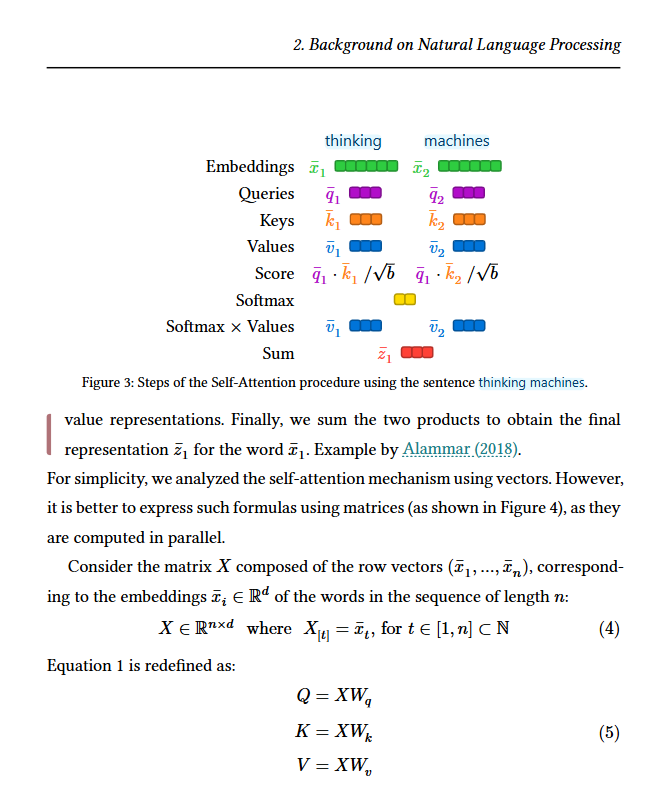
#let tt(body) = {
    highlight(fill: aqua.transparentize(80%), radius: 30%)[#text(
      font: "Manrope", // Any sans-serif font would work
      size: 0.85em,
      fill: blue.darken(50%),
    )[#body]]
}

#let ve(body) = math.dash(math.bold(body))
#let veq = ve($q$)
#let vek = ve($k$)
#let vev = ve($v$)
#let vex = ve($x$)
#let vez = ve($z$)

#let vector-txt(dim, color: green) = {
  let cell-size = 0.25cm
  stack(
    spacing: 0pt,
    dir: ltr,
    ..range(dim).map(i => box(
      fill: color.lighten(20%),
      stroke: 1pt + color.darken(30%),
      width: cell-size,
      height: cell-size,
      radius: 25%,
    ))
  )
}

#let table-row(name, dim, formula, color: green) = (
  align(right)[#name],
  stack(text(color)[$formula_1$], vector-txt(dim, color: color), dir: ltr, spacing: 2mm),
  stack(text(color)[$formula_2$], vector-txt(dim, color: color), dir: ltr, spacing: 2mm),
)

#figure(
  table(
    columns: 3,
    stroke: none,
    fill: none,
    [], h(1.5em)+tt[thinking], h(1.5em)+tt[machines],
    ..table-row("Embeddings", 6, $vex$),
    ..table-row("Queries", 3, $veq$, color: purple),
    ..table-row("Keys", 3, $vek$, color: orange),
    ..table-row("Values", 3, $vev$, color: blue),
    align(right)[Score], [#text(purple)[$veq_1$] $dot$ #text(orange)[$vek_1$] $ \/ sqrt(b)$], [#text(purple)[$veq_1$] $dot$ #text(orange)[$vek_2$] $ \/ sqrt(b)$],
    align(right)[Softmax], table.cell(colspan: 2)[
      #stack(
        dir: ltr,
        spacing: 2mm,
        vector-txt(2, color: yellow),
      )
    ],
    ..table-row([Softmax $times$ Values], 3, $vev$, color: blue),
    align(right)[Sum], table.cell(colspan: 2)[
      #stack(
        dir: ltr,
        spacing: 2mm,
        text(red)[$vez_1$],
        vector-txt(3, color: red),
      )
    ]
  ),
  caption: [Steps of the Self-Attention procedure using the sentence #tt[thinking machines].],
  kind: image,
  placement: auto,
)
Source code
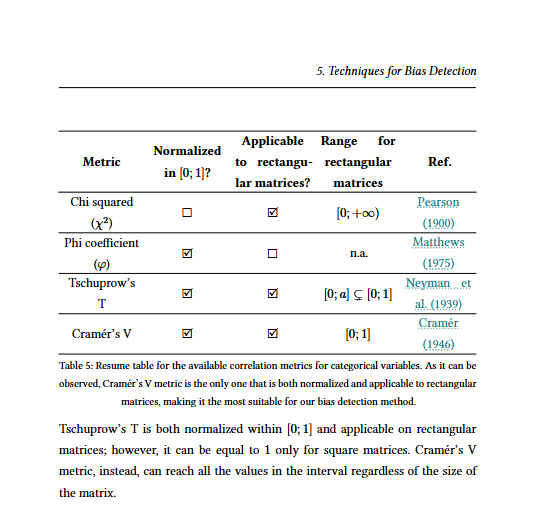
#figure(
  table(
    columns: (1fr, 1fr, 1fr, 1fr, 2.5cm),
    align: center + horizon,
    stroke: (x: none, y: 0.5pt),
    table.header([Metric], [Normalized\ in $[0; 1]$?], [Applicable to rectangular matrices?], [Range for rectangular matrices], [Ref.]),
    table.hline(stroke: 1pt),
    [Chi squared\ ($chi^2$)], sym.ballot, sym.ballot.check.heavy, [$[0; + oo)$], [],
    [Phi coefficient\ ($phi$)], sym.ballot.check.heavy, sym.ballot, [n.a.], [],
    [Tschuprow's T], sym.ballot.check.heavy, sym.ballot.check.heavy, [$[0; a] subset.neq [0; 1] $], [],
    [Cramér's V], sym.ballot.check.heavy, sym.ballot.check.heavy, $[0; 1]$, [],
  ),
  caption: [Resume table for the available correlation metrics for categorical variables. As it can be observed, Cramér's V metric is the only one that is both normalized and applicable to rectangular matrices, making it the most suitable for our bias detection method.],
)
<tab:label>


