Hi everyone! I’m introducing Typsastra, an open-source, local-first desktop writing environment for Typst.
Typsastra is designed for research papers, theses, books, technical documentation, and other long-form multilingual projects. Its main focus is making complex-script authoring a core editor concern, not only ensuring that text renders, but also handling cursor movement, deletion, segmentation, spellchecking, completion, and mixed-script text correctly.
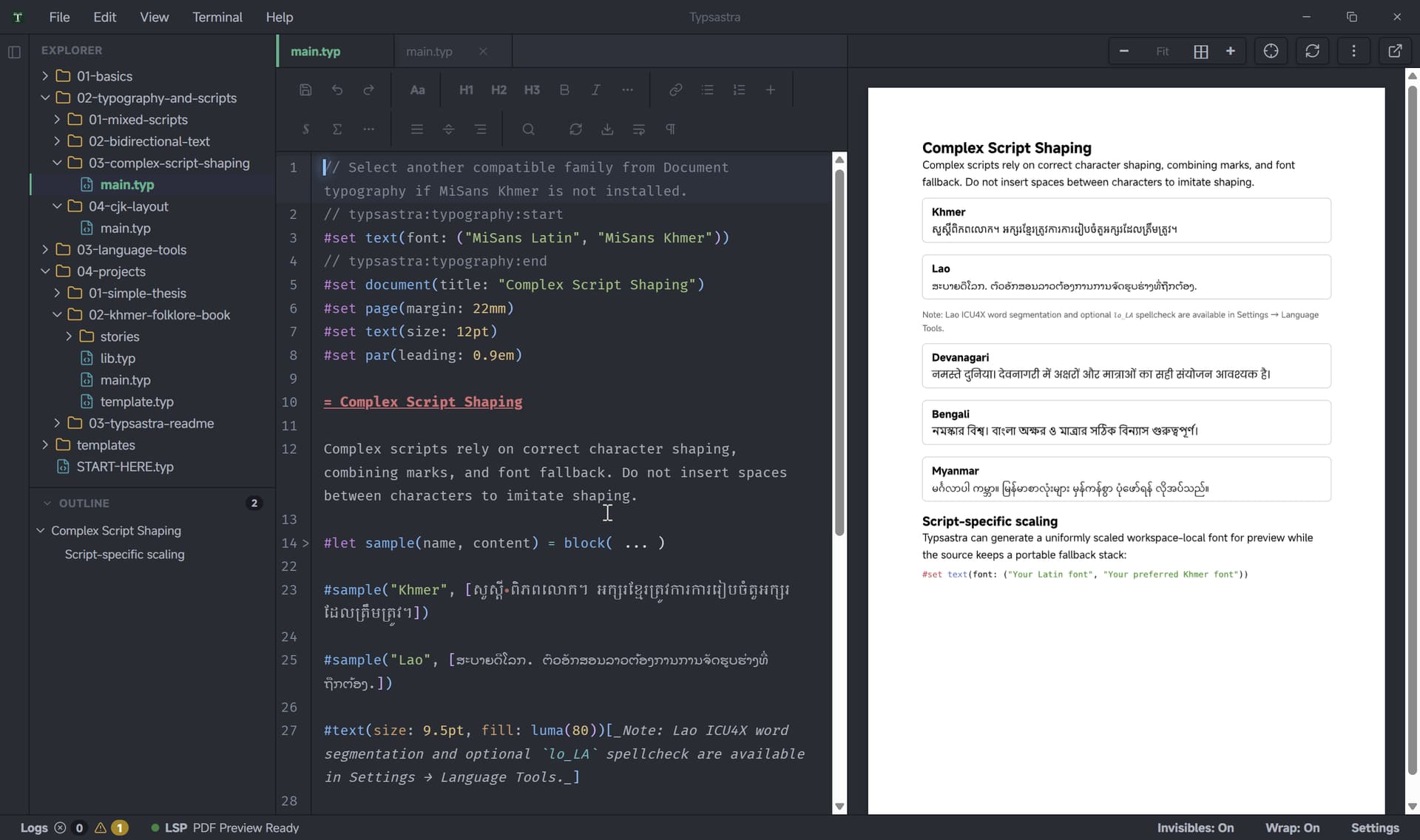
What makes Typsastra different?
Complex-script-first editing
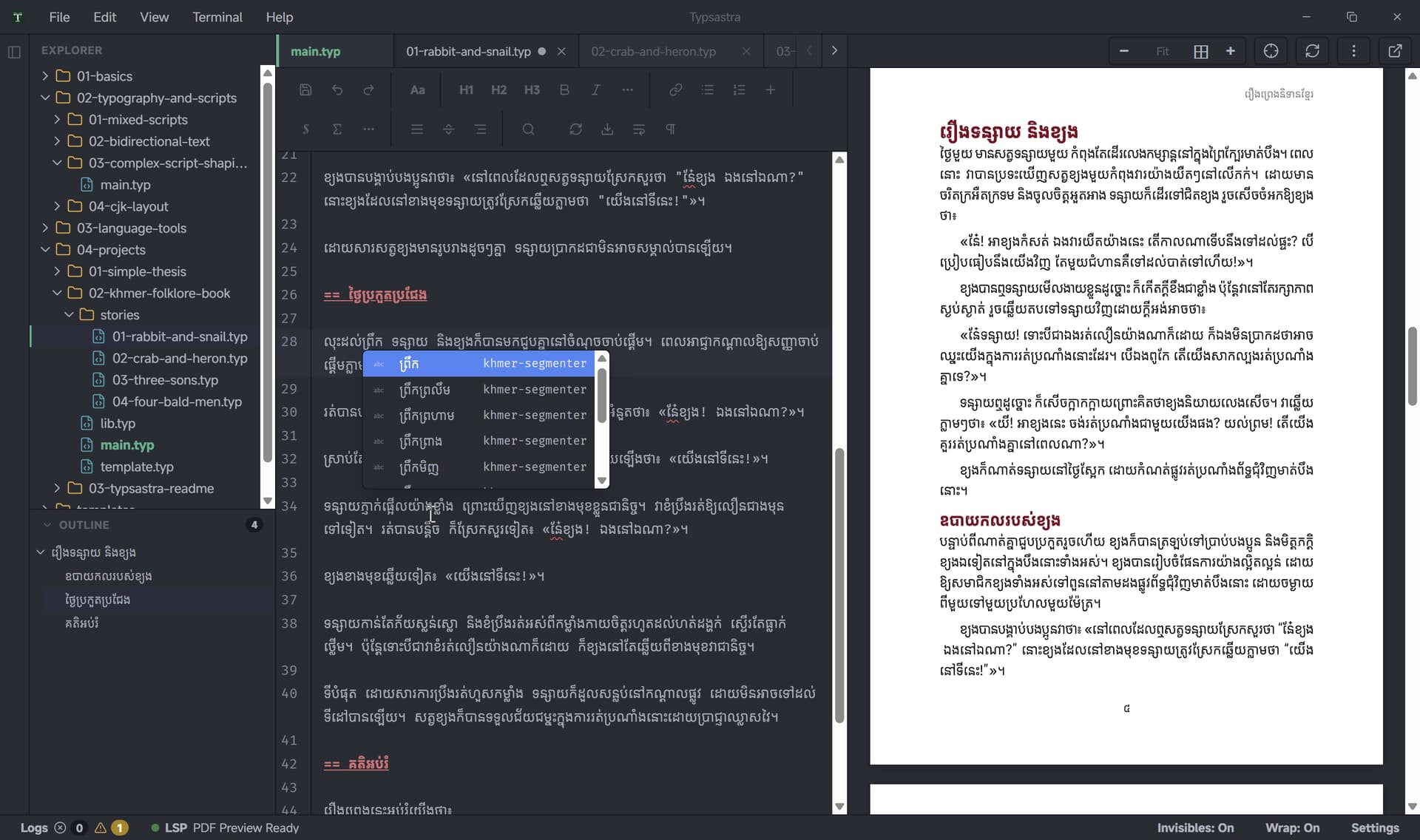
Khmer is currently the reference language with deep support, including script-aware cursor and deletion behavior, deterministic word segmentation, spellchecking, and word completion.
Lao currently has enhanced support through language-specific segmentation and an optional dictionary. The language-provider architecture is designed so contributors can add support for more languages without modifying the generic editor integration or existing Khmer behavior.
Long-document and project workflows
Typsastra treats a document as a project rather than an isolated file. It supports:
- a configured main Typst document;
- included chapters and imported files;
- bibliographies, figures, templates, and other project assets;
- full-document preview while editing included files;
- standalone preview when needed;
- virtualized PDF rendering for large documents;
- source-to-preview navigation.
Managed Typst tooling
Typsastra manages Tinymist for compilation, diagnostics, preview, and source synchronization. A separate Typst installation is normally not required.
Your documents remain ordinary Typst source files and are not locked into a proprietary format.
Current status
Typsastra is currently beta software, with v0.4.1 as the latest public release.
Windows and Linux are the most actively tested platforms. The macOS build is currently experimental.
The v0.4.x releases will focus mainly on bug fixes, performance improvements, and smaller additions. Planned later work includes bidirectional/RTL editing, broader language support, bibliography and figure workflows, document builders, templates, and additional long-document tooling.
Links
- GitHub: GitHub - Sovichea/typsastra: A complex-script-first Typst environment for research and long-form multilingual writing. Built with Tauri, Bun, and CodeMirror 6. · GitHub
- Download: https://github.com/Sovichea/typsastra/releases/latest
Typsastra is released under the MIT License.
I would especially appreciate feedback from:
- people writing multilingual or complex-script documents;
- authors working with large, multi-file Typst projects;
- native speakers interested in contributing language support;
- Windows, Linux, or macOS users willing to test the beta.
Which languages or writing-system behaviors are currently difficult to use in your Typst workflow? I’d also be interested in feedback on the project model, preview workflow, installation experience, and documentation.
Thank you!