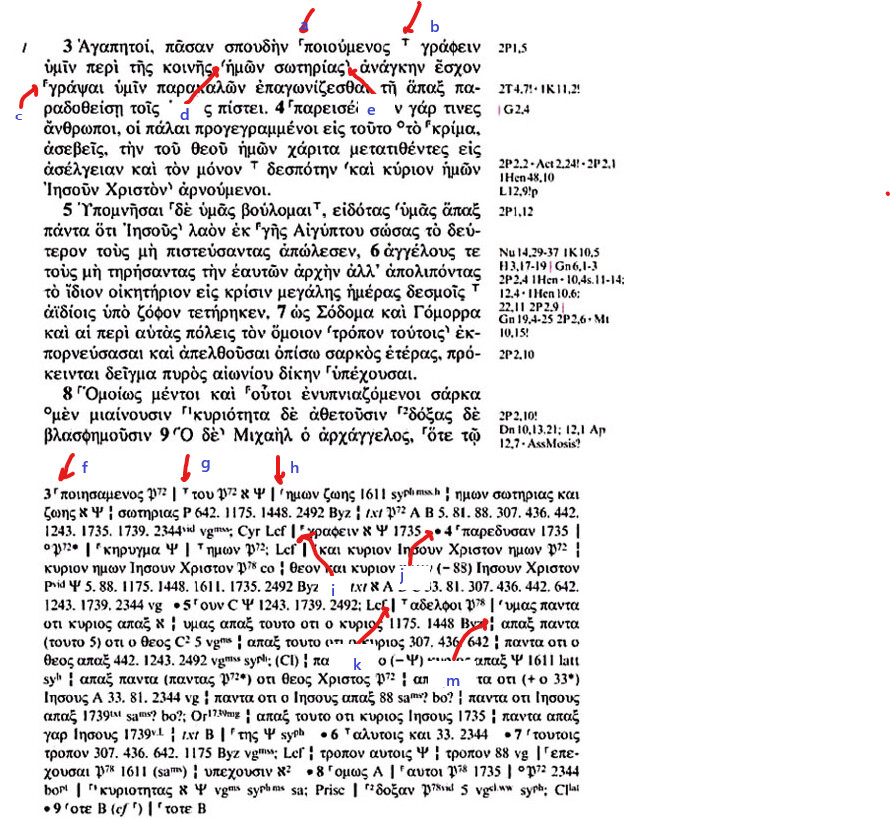
Is it infeasible at this point to typeset a critical edition of the Greek New Testament using typst? By “critical edition,” I mean features such as the following:
Notes appear in an apparatus at the bottom of the page, and the notes are in run-on paragraph form.
“Lemmas” (i.e., a stretch of zero or more words) are marked in the text using text critical symbols, rather than showing footnote callers in the main text.
Notes in the apparatus that correspond to lemmas are usually marked with a verse or line number, rather than a footnote caller, to show what stretch of main text goes with what note.
Notes in the apparatus are marked differently, depending on whether they are the first note for that verse/line or not. For example, the first note that occurs for a particular verse might be marked with the verse number, but subsequent notes for that same verse appear with a separator character in front of them instead of the verse number.
Is this outside the realm of what typst is designed for?
If you can share maybe a screenshot of a page that demonstrates most of these, that would be super useful. But I hope I understand most of your requirements.
There are also at least two other topics regarding critical editions, maybe they are also relevant:
that means that this “footnote” would be broken across two (facing) pages if it becomes very long? That’s definitely not supported. My best guess is that it could somehow be simulated by Meander, but also only with some extra work.
This sounds somewhat more feasible; a function could insert a footnote that doesn’t use the regular marker. The last point sounds similar to citations using ibid. It would not be built-in for your use case, but I think it could be implemented.
This is only one type of critical edition, but it’s the one I’m interested in emulating.
General features are:
the typesetting engine is aware that stretches of main text are assigned a chapter and verse number.
there exists a main text block, marginal notes, and a note apparatus.
the apparatus shows its notes in run-on paragraph form.
At (a) through (e) you can see that I highlight text-critical symbols that are in the text to mark (a) a single word of the main text that is replaced by another word or words in the apparatus, (b) a place where text in the apparatus would be inserted into the main text, (c) another place where a single word from the main text will be replaced by one or more words in the apparatus. Markers (d) and (e) surround a stretch of main text that will be replaced by one or more words in the apparatus.
At (f) through (i) you can see in the apparatus the notes that correspond to the markers.
At (j) you can see a verse number in the apparatus, and a decorative middle dot that precedes it. Markers (k) and (m) show the vertical bar symbols that separate different variant units and different readings for a single variant unit, respectively.
Packages like reledmac also allow you to have multiple footnote apparatuses. In reledmac world, they refer to normal footnotes that are marked by a footnote caller (like a series of preset symbols, a letter or a number) in the main text and apparatus as “familiar” notes. Notes that are marked by lemmas in the main text are called “critical” notes. In any case, reledmac allows you to, for example, have one apparatus that is familiar notes, and two that are critical notes. And for either type of apparatus, you can choose run-on paragraph notes, one note per line (like you currently do in typst), or notes in two or more columns. You can also generally control whether the apparatuses are separated from the main text and each other by a horizontal rule. And it would allow you to control whether the rule goes all the way across the page, part way across, the line thickness, etc.
Although it’s not shown in the example above, critical editions frequently need to typeset poetry. And they often need to mark sections of the main text using line numbers, rather than chapter and verse numbers.
Thanks for the response! I probably won’t be able to look into the details (so I’m leaving this message in case others feel encouraged to tackle this).
run-on paragraphs and verse numbering are possibly the biggest issues; Typst has some support for line numbering but afaik it’s not super flexible.
The other problem I foresee tackling this in “user space” is convergence: the main and apparatus compete for area on the page, and if content is shifted from one page to the next that can take notes with it.
Overall it would probably be a fairly big undertaking. It may be possible, but definitely on the harder end of the spectrum.
Absolutely: The more notes you have, the less main content will fit on the page, and vice versa. So at times LaTeX will actually get “stuck” trying to decide whether to shift a note (and some main text content) to the next page. I’d imagine from a typesetting standpoint, it’s a very complicated problem.
that means that this “footnote” would be broken across two (facing) pages if it becomes very long? That’s definitely not supported. My best guess is that it could somehow be simulated by Meander, but also only with some extra work.
Sorry, just realized I didn’t respond to all of what you posted.
So in terms of a footnote wrapping around into another page…it’s expected that that could happen. However, it would not be desirable. So if it was simply truncated, rather than wrapping onto a facing page, that would be acceptable. It would simply signal that the writer would need to adjust things so that there’s no wrapping of the note.
In any case, it sounds like it might currently be out of reach in terms of typst.