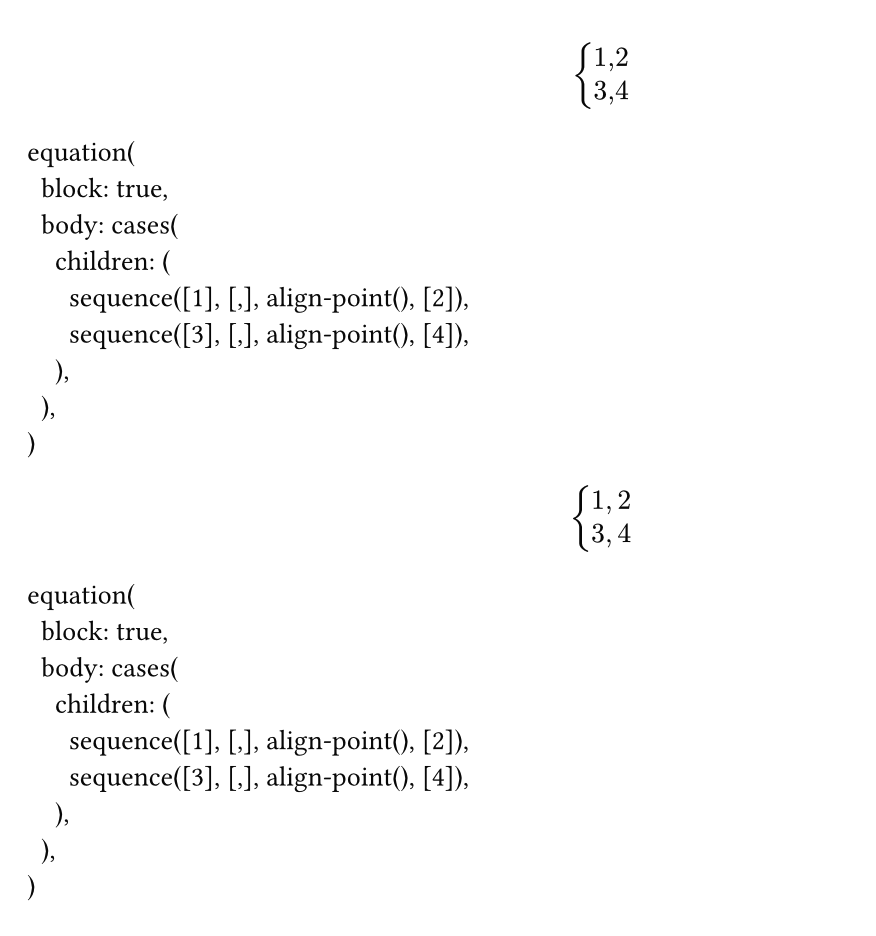
However, there is no spacing before align-point(& in math mode) in mycases, but there is if I directly call cases. The repr function seems to show that the result code are the same. I have no idea why they look different.
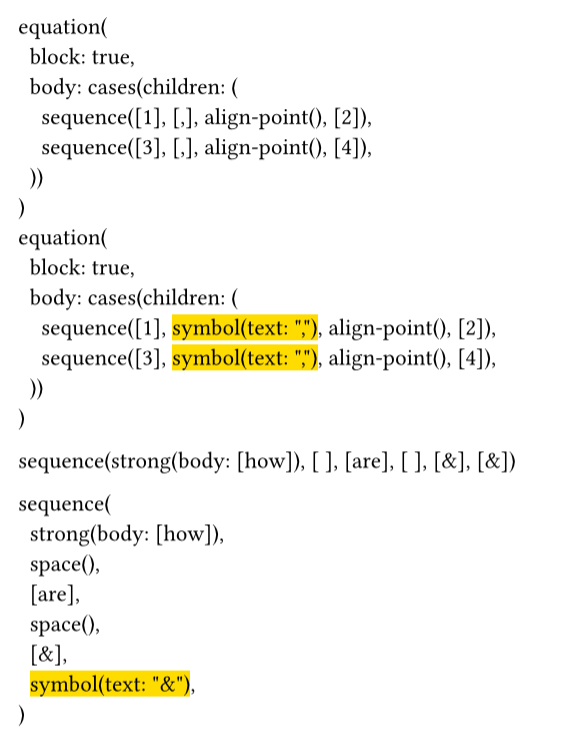
I’m not sure why, but i’ve also noticed that using repr is not 100% reliable, as it doesn’t distinguish between some internal states. One example, as you noticed, is "," and $\,$.body. It’s weird, because doing #{repr(u) == repr(v)} evaluates to true, but #{u == v} evaluates to false.
Luckily, the fix is simple: just use math commas, i.e. $\,$.body, instead of "," :)
I’ve actually seen that in the document. I understand that some functions, like sequence(...) or align-point(), can’t be handled by eval. If we’re not concerned with eval, I’d just love a more verbose printing function to make debugging easier.
Here’s an alternate repr function that shows the distinction. It is not fully fleshed out and doesn’t handle all indentation cases!
#let sequence = [].func()
#let math-symbol = $,$.func()  // the function type called "symbol" below

#let vrepr(elt, indent: 0) = {
  let vrepr = vrepr.with(indent: indent + 1)
  if type(elt) == array {
    let children = elt.map(vrepr)
    let child-len = calc.max(0, ..children.map(c => c.len()))
    let long-form = child-len > 20 or children.len() > 5
    "("
    if long-form {
      "\n"
      for child in children {
        "  " * indent
        child
        ",\n"
      }
      "  " * (indent - 1)
    } else {
      children.join(", ")
    }
    ")"
    return
  }
  if type(elt) != content {
    return std.repr(elt)
  }
  if elt.func() == text {
    repr(elt)
  } else if elt.func() == sequence {
    "sequence"
    vrepr(elt.children)
  } else {
    let fields = elt.fields()
    let newline = fields.len() > 1
    if newline {
      "\n"
      "  " * indent
    }
    vrepr(elt.func())
    if fields.len() == 0 {
      "()"
    } else if fields.len() == 1 {
      "("
      fields.pairs().map(((k, v)) => {k; ": "; vrepr(v)}).join()
      ")"
    } else {
      indent += 1
      "(\n"
        fields.pairs().map(((k, v)) => {
          "  " * indent
          k
          ": "
          vrepr(v, indent: indent)
        }).join(",\n")
      "\n)"
    }
  }
}


#let mycases(..array) = math.cases(..array.pos().map(it => (it.at(0) + "," + $&$.body + it.slice(1).join(", "))))

#let u = $ mycases(1, 2; 3, 4) $
#vrepr(u)
#let v = $ cases(1\,&2, 3\,&4) $
#vrepr(v)

#repr[*how* are &\&]

#vrepr[*how* are &\&]
Picture below: vrepr for cases and mycases with difference highlighted (the symbol content function, which is not the same as std.symbol). The highlight is something I added.