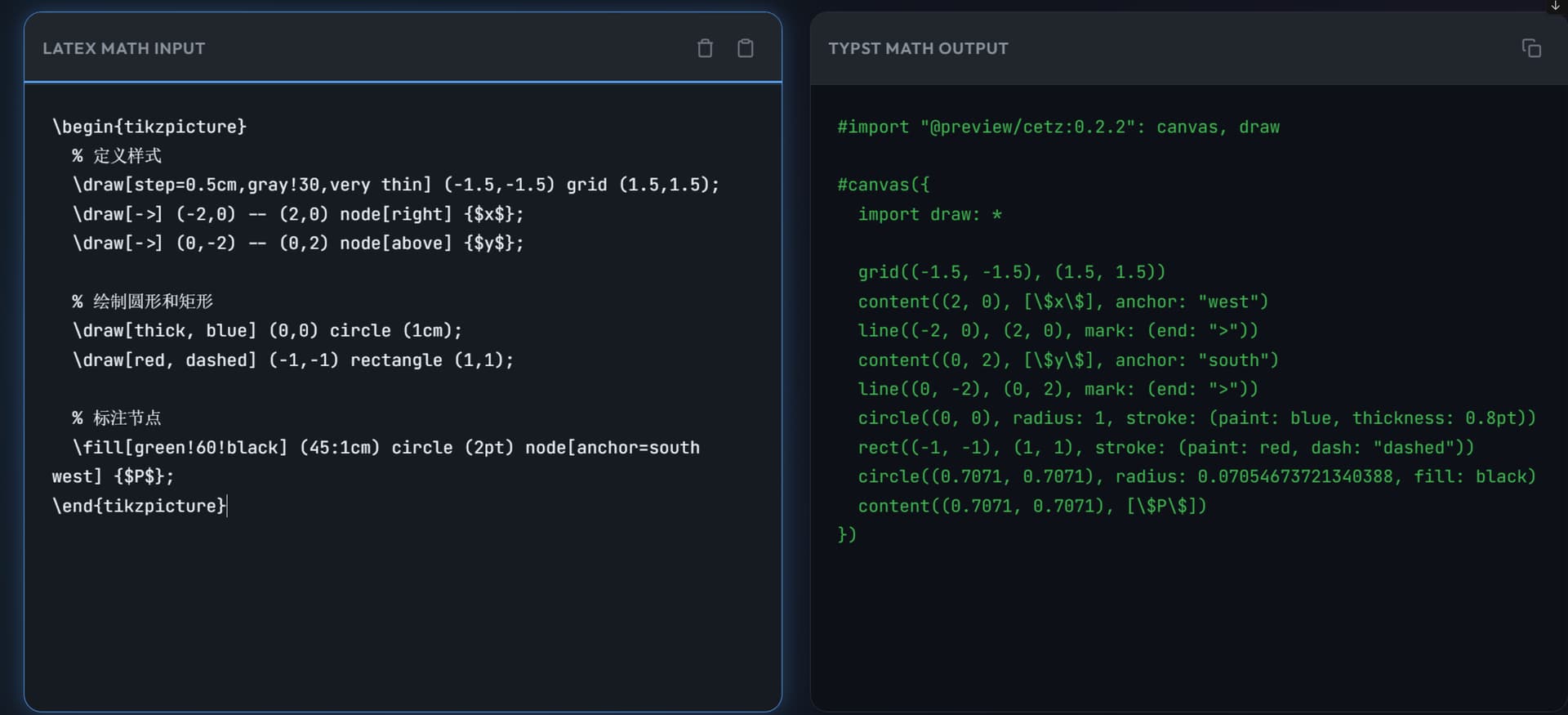
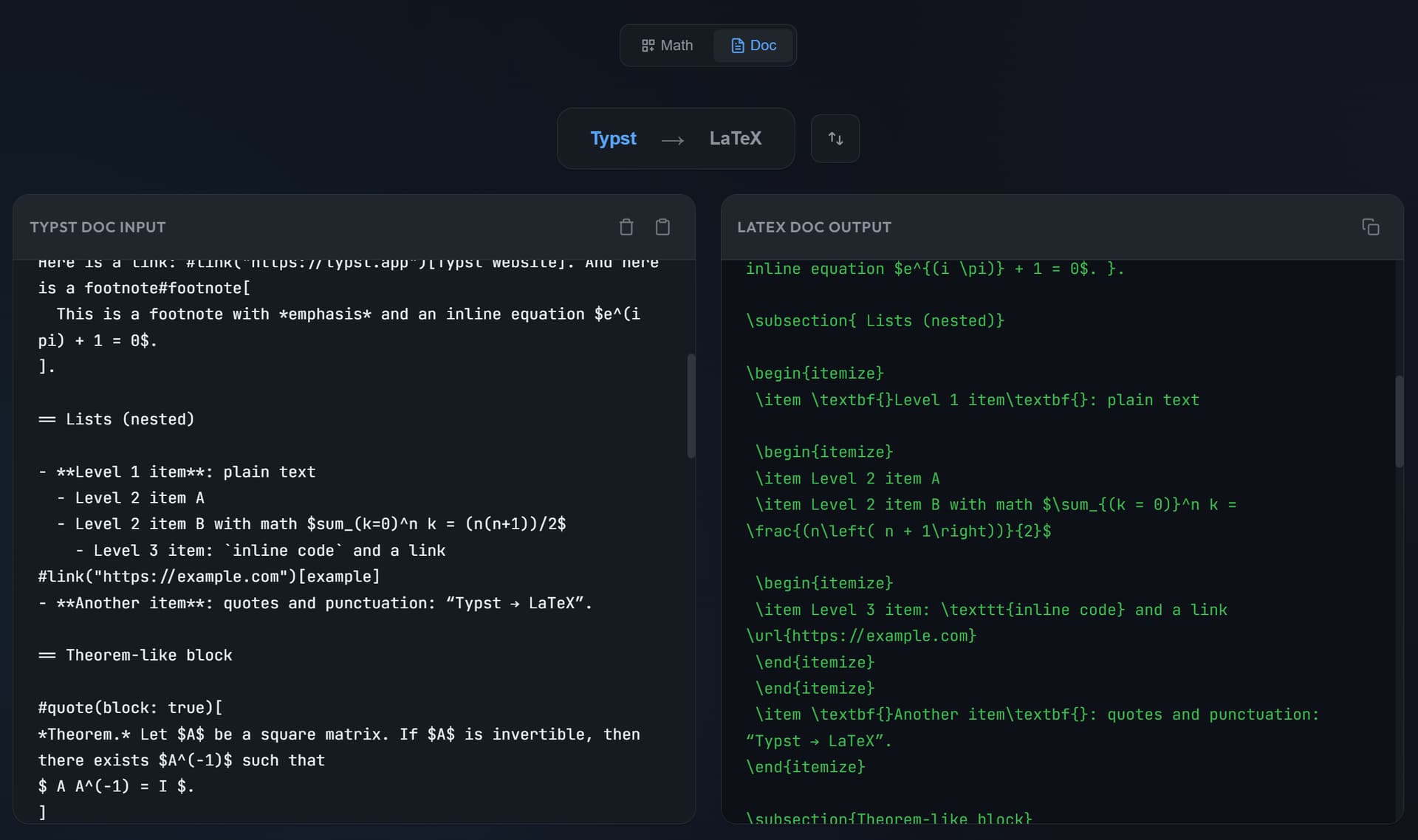
Thank you for your reply. I plan to open-source this tool. I’m currently organizing my code and will soon make it publicly available on GitHub, continuously updating and maintaining it based on user feedback.
One point: Could you also set https://convert.silkyai.cn/ as the homepage of the GitHub repo?
If you do so, it can be automatically fetched by the best-of generator, and get updated if you change the domain name in the future.
The setting is at the top-right corner of the repo’s main page.
Incredible work, thank you! It will definitely be useful for me (so far I relied on a regex monster to do my conversions).
A few edge cases I identified:
The LaTeX $\macro$ gets converted to the Typst $macro$, but the Typst $macro$ gets converted to the LaTeX $macro$ (without the slash). I would be nice to enforce the slash, so that in LaTeX we don’t forget to define \macro and put the pretty \mathit formatting.
The LaTeX $ 1$ gets converted to the Typst $ 1 $. An extra space has been added at the end. This can pose a problem because an inline LaTeX equation became a centered Typst equation.
Thank you for using this feature. I will assess the workload and implementation difficulty and then add it. It’s something I will do; it’s just a matter of time. Thank you!
I personally had trouble using Pandoc because, in my case, it tried to be too smart and check some of the semantics of my document to ensure it produced a compilable document out of the box (and if it couldn’t, it just panicked). This happened frequently in my attempts, as I have several Typst packages (including custom ones) in my projects, for which the mapping to LaTeX is not always straightforward.
What I want is simply “dumb” syntactic rules that convert some LaTeX elements to Typst and vice-versa, without failing when it is not always to do a full conversion that compiles perfectly.