This is meant to be printed out, so I didn’t much bother with all the semantic pdf stuff.
// Half of a US letter sheet.
#set page(
    width: 4.25in,
    height: 11in,
)
#set text(
    font: "EB Garamond"
)

// Need to use this because the boxes mess up normal parbreak spacing.
#let par-space = v(0.1in)

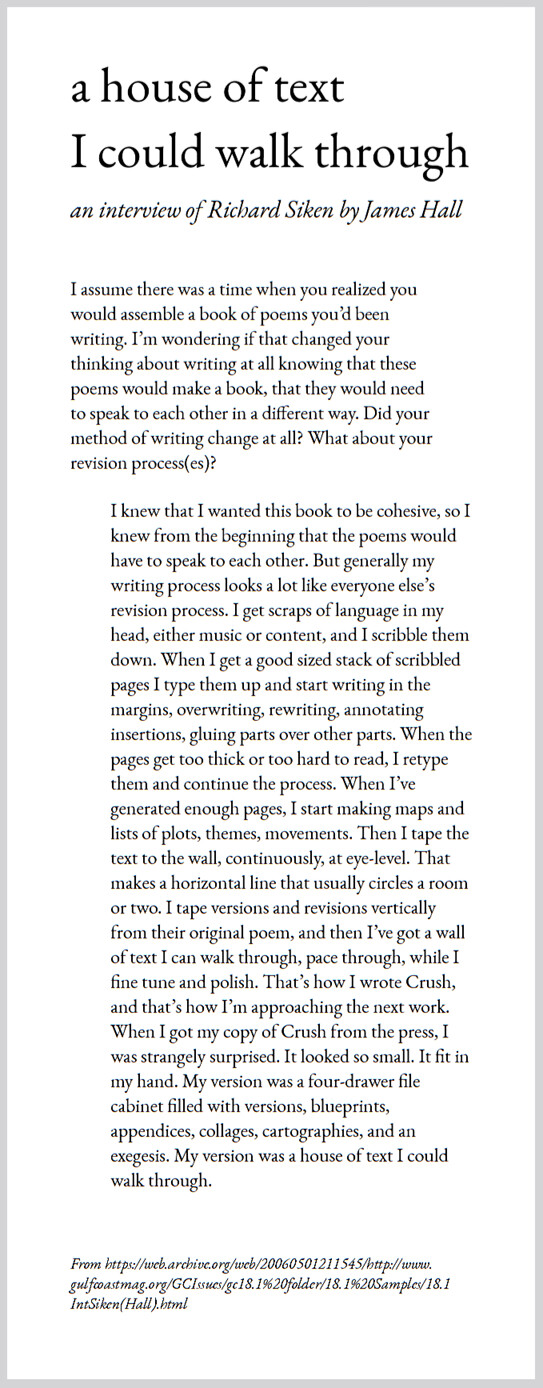
#text(size: 0.4in)[a house of text\ I could walk through]

#v(-0.2in)
#text(size: 0.19in, style: "italic")[an interview of Richard Siken by James Hall]

#v(0.3in)
#box(width: 90%)[
    I assume there was a time when you realized you would assemble a book of poems you'd been writing. I'm wondering if that changed
    your thinking about writing at all knowing that these poems would
    make a book, that they would need to speak to each other in a different
    way. Did your method of writing change at all? What about your revision process(es)?
]

#par-space

#box(inset: (left: 10%))[
    I knew that I wanted this book to be cohesive, so I knew from
    the beginning that the poems would have to speak to each other. But
    generally my writing process looks a lot like everyone else's revision
    process. I get scraps of language in my head, either music or content,
    and I scribble them down. When I get a good sized stack of scribbled
    pages I type them up and start writing in the margins, overwriting,
    rewriting, annotating insertions, gluing parts over other parts. When
    the pages get too thick or too hard to read, I retype them and continue
    the process. When I've generated enough pages, I start making maps
    and lists of plots, themes, movements. Then I tape the text to the wall,
    continuously, at eye-level. That makes a horizontal line that usually
    circles a room or two. I tape versions and revisions vertically from
    their original poem, and then I've got a wall of text I can walk through,
    pace through, while I fine tune and polish. That's how I wrote Crush,
    and that's how I'm approaching the next work. When I got my copy of
    Crush from the press, I was strangely surprised. It looked so small. It fit
    in my hand. My version was a four-drawer file cabinet filled with versions, blueprints, appendices, collages, cartographies, and an exegesis.
    My version was a house of text I could walk through.
]

#v(0.4in)

#text(size: 0.8em, emph[From #link("https://web.archive.org/web/20060501211545/http://www.gulfcoastmag.org/GCIssues/gc18.1%20folder/18.1%20Samples/18.1IntSiken(Hall).html")])

// #emph[From #link("https://web.archive.org/web/20060501211545/http
// ://www.gulfcoastmag.org/GCIssues/gc18.1%20folder/18.1%20Samples/18.1IntSiken(Hall).html")]