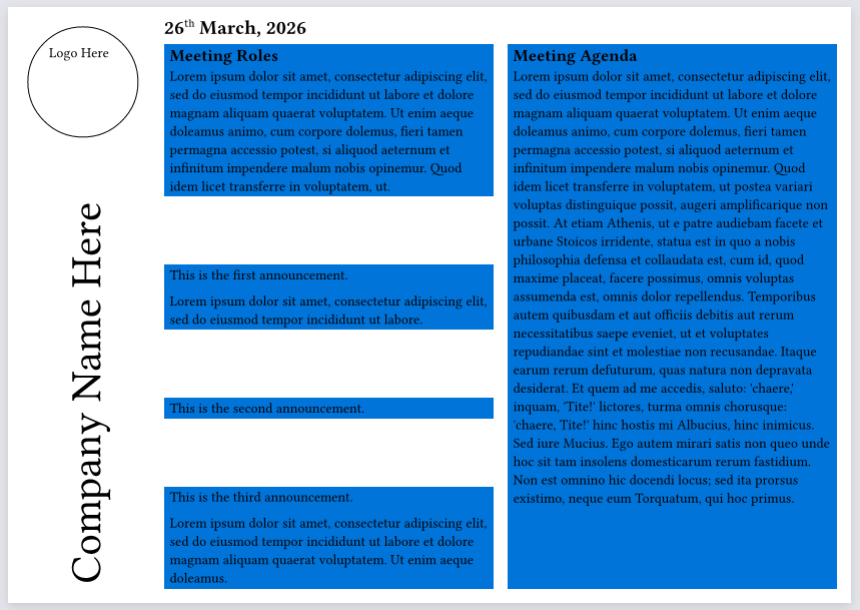
The grid row-gutter is manually set to 2.4cm; I’d like to set it to something that just balanced the gaps, but 1fr breaks the layout entirely, for reasons I’m unclear on.
#set page(
  margin: 0.5cm,
  flipped: true
)
#set text(14pt)
#show heading.where(level: 3): underline
#let sidebar = {
  circle(radius: 55pt)[Logo Here]
  show heading.where(level: 1): set text(18pt)
  show heading.where(level: 2): set text(14pt)
  set align(bottom + center)
  rotate(270deg, reflow: true, {
    text(43pt)[Company Name Here]
  })
}
#let roles = {
  heading(level: 2)[Meeting Roles]
  lorem(50)
}
#let agenda = {
  heading(level: 2)[Meeting Agenda]
  lorem(180)
}

#set rect(width: 100%, stroke: none, inset: 0.2cm)

#grid(
  columns: (4.5cm, 1fr),
  column-gutter: 0.5cm,
  rect(
    height: 100%,
    sidebar
  ),
  {
    heading(level: 1)[26#super[th] March, 2026]
    block(
      height: 1fr,
      grid(
        fill: blue,
        columns: (1fr, 1fr),
        column-gutter: 0.5cm,
        row-gutter: 2.4cm, // Why does 1fr not work here?
        rect(
          roles
        ),
        grid.cell(rowspan: 4, {
          rect(
            height: 100%,
            agenda
          )
        }),
        rect(
          [This is the first announcement.

          #lorem(15)]
        ),
        rect(
          [This is the second announcement.]
        ),
        rect(
          [This is the third announcement.

          #lorem(25)
          ]
        )
      )
    )
  }
)
This is perhaps not quite as minimal an example as I could have come up with, but it’s fairly small. I could probably have made it smaller. Also visible online at Typst